

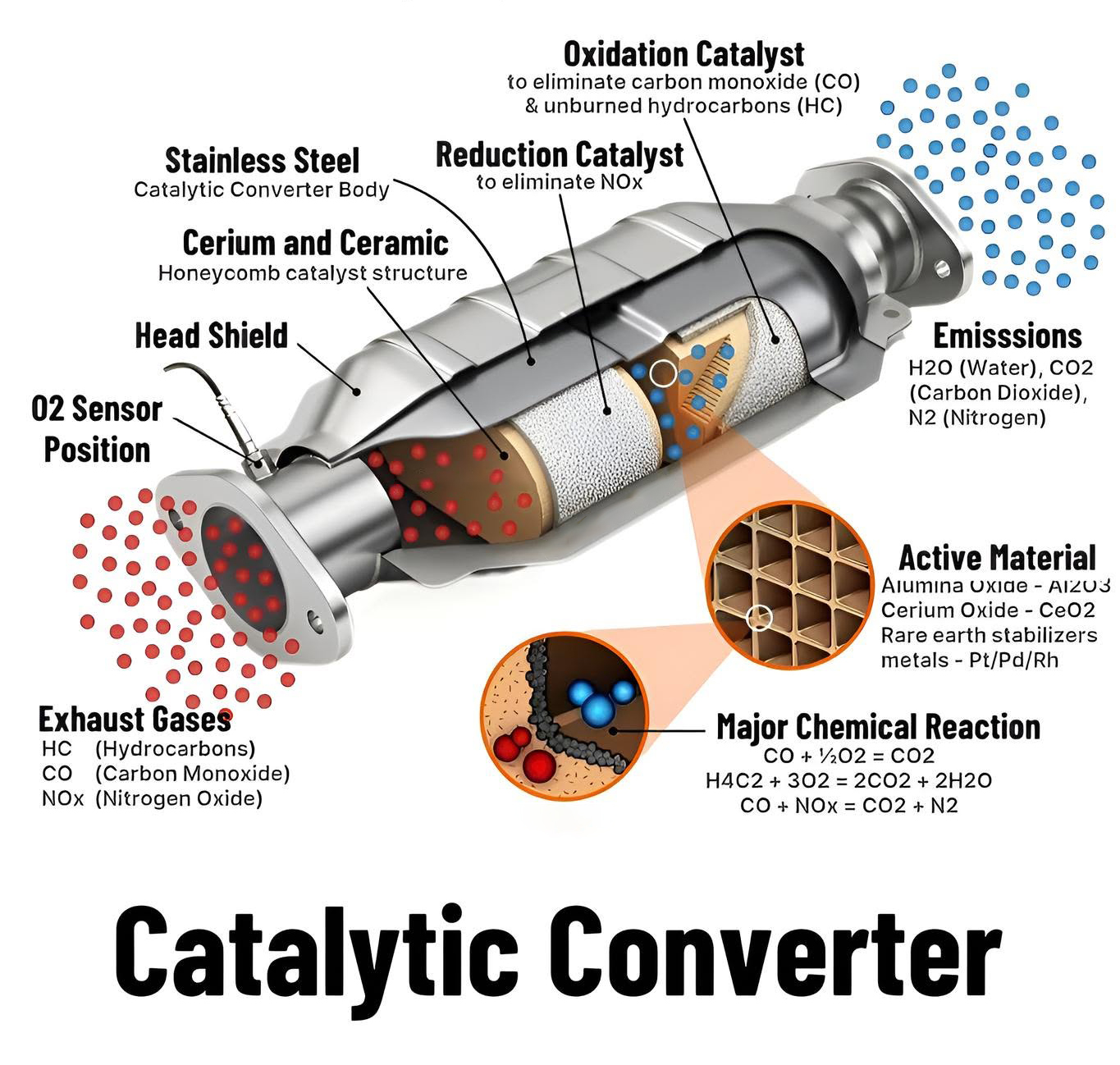
A vehicle’s catalytic converter changes carbon monoxide, hydrocarbons and nitrous oxide into less harmful pollutants. All new cars in Europe have had to have them fitted since 1993, while they’ve been fitted to cars in the US since 1975. Almost every developed country requires every car to have one.
Catalytic converter issues
Catalytic converter problems include impact damage (the matrix can be destroyed if the underside of the car hits an object), a faulty lambda sensor, poor fitting, unburnt fuel in the exhaust (which increases the temperature beyond tolerable levels and causes it to melt) and water damage – the rapid cooling of the matrix (after driving through a ford, for example) can cause the honeycomb matric to break apart.
A catalytic converter works with the lambda sensor and the auto’s ECU. The sensor tells the car’s computer how much oxygen is in the exhaust gases and the engine management system alters the air-fuel mix accordingly. If the sensor or ECU are faulty, the wrong mix can result in damage to the cat.
How long does a catalytic converter last?
You should expect a cat to last at least 10 years but most last the life of the vehicle – as long as it isn’t affected by any of the external influences mentioned above.
It’s illegal to remove a catalytic converter in Australia because it’s an emissions violation.
Post time: Jun-18-2026