High-Temperature Ceramic Filter Plates (Al₂O₃/SiC/ZrO₂) for Efficient Molten Metal Filtration in Foundry


High-Temperature Ceramic Filter Plates (Al₂O₃/SiC/ZrO₂) for Efficient Molten Metal Filtration in Foundry
Short Description:
Overview of Ceramic Foam Filters (CFFs)
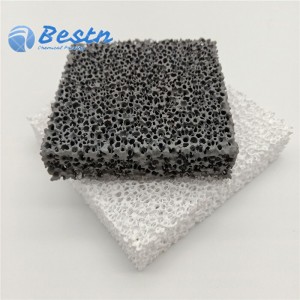
Ceramic Foam Filters are essential components in modern precision casting, used to enhance the cleanliness of molten metal and improve casting quality. These filters primarily remove non-metallic inclusions such as oxides, slag, and sand particles through a combination of deep-bed filtration, adsorption, and flow stabilization.
| Comparison of Key Properties | |||
| Property | Alumina Ceramic Filter (Al₂O₃) | Silicon Carbide Ceramic Filter (SiC) | Zirconia Ceramic Filter (ZrO₂) |
| Main Composition | Aluminum Oxide (Alumina) | Silicon Carbide | Zirconium Oxide (stabilized with Y₂O₃, etc.) |
| Key Advantages | Cost-effective, versatile, excellent chemical stability. | Exceptional strength, high thermal conductivity, superior thermal shock resistance. | Ultra-high temperature resistance, excellent toughness, outstanding corrosion resistance. |
| Max Service Temp | High (~1750°C) | Very High (~1600°C in air, stable in molten iron with SiO₂ layer) | Extremely High (>2200°C) |
| Thermal Shock Resistance | Good | Excellent (rapid heat dissipation) | Exceptional (phase transformation toughening) |
| Mechanical Strength | High | Very High (high hardness & wear resistance) | Extremely High (highest fracture toughness) |
| Chemical Stability | Excellent in oxidizing atmospheres; resistant to many molten metals. | Stable in oxidizing atmospheres; may corrode in strong oxidizers/alkalis. | Outstanding resistance to corrosive/active molten metals. |
| Typical Cost | Economical | Moderate to High | Premium |
Application Guidelines & Selection
1. Alumina (Al₂O₃) Filters
Positioning: The All-Rounder – Best balance of performance and cost.
Ideal Applications:
Aluminum & Magnesium Alloy Casting (most common, cost-effective).
Cast Iron & General Steel filtration.
Copper & Zinc Alloy casting.
Summary: The default, reliable choice for a wide range of non-ferrous and some ferrous applications where cost is a consideration.
2. Silicon Carbide (SiC) Filters
Positioning: The High-Strength Thermal Shock Resistor.
Ideal Applications:
High-Temperature Molten Iron (e.g., ductile iron, compacted graphite iron) – excellent resistance to thermal shock.
Large castings or long pouring times requiring sustained filter integrity.
Applications demanding very high mechanical strength and abrasion resistance.
Summary: The preferred choice for demanding ferrous metal casting where thermal shock and mechanical stability are critical.
3. Zirconia (ZrO₂) Filters
Positioning: The Premium Specialist for Extreme Conditions.
Ideal Applications:
Superalloys & High-Temperature Alloys (e.g., nickel-based, cobalt-based).
Reactive/alloy steels (e.g., stainless steel, high-manganese steel) to avoid contamination.
Titanium alloy melting (in specific processes).
High-integrity castings for aerospace, medical, or investment casting where ultimate purity is required.
Summary: The top-tier solution for the most challenging environments involving the highest temperatures and most corrosive/active molten metals.
Summary & Recommendation
Filtering Aluminum, Prioritizing Cost → Choose Alumina.
Filtering High-Temperature Iron, Prioritizing Durability → Choose Silicon Carbide.
Filtering Specialty Steels/Alloys, Prioritizing Purity & Performance → Choose Zirconia.
Note: Final selection should also consider pore size (e.g., 10 PPI, 20 PPI), filter dimensions, and specific casting parameters. Consultation with a technical specialist is always recommended.
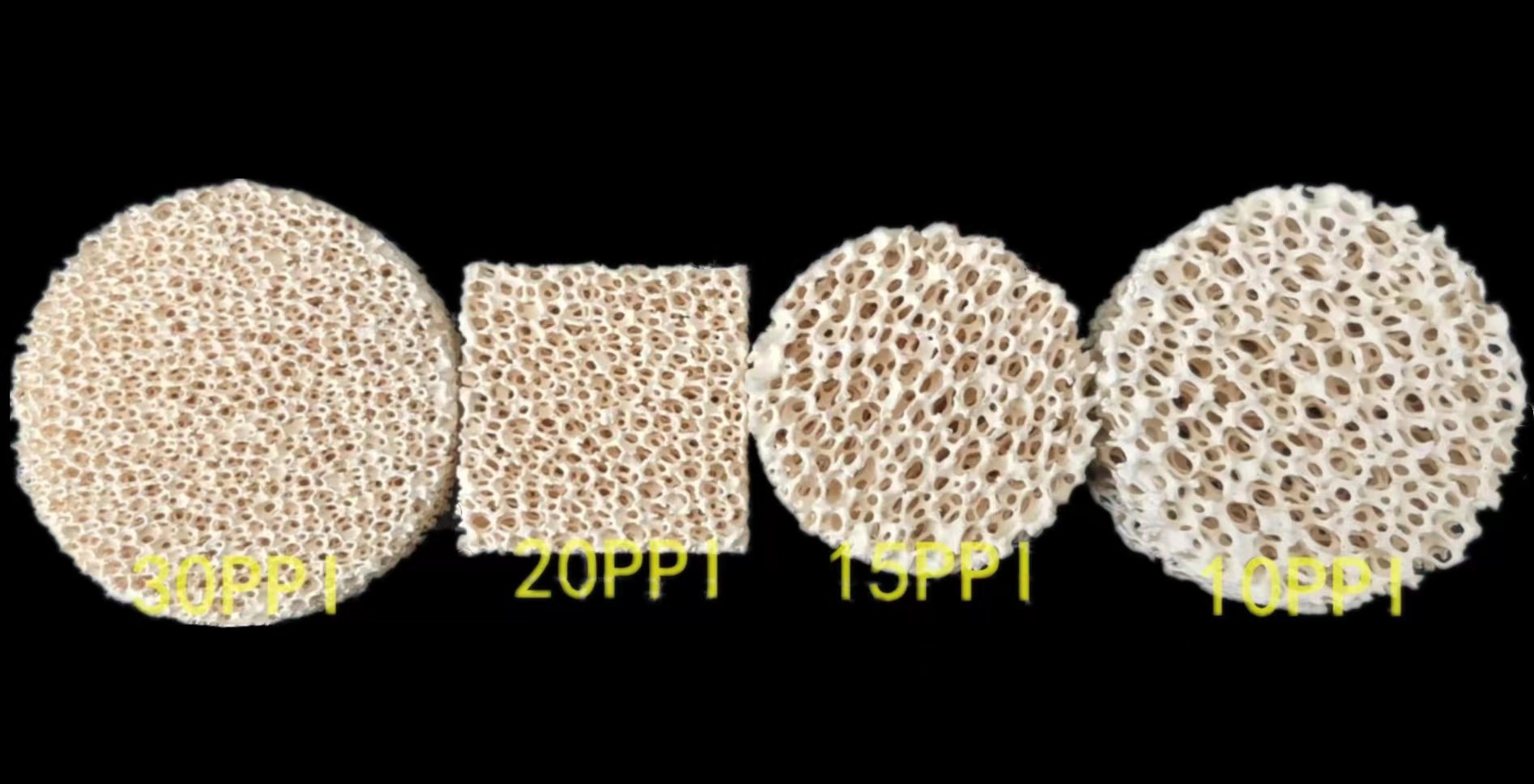
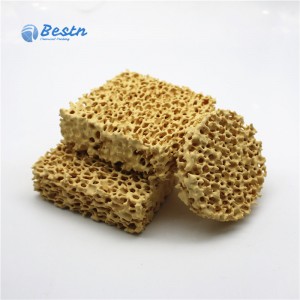
Zirconia Ceramic Foam Filter is a phosphate-free, high melting point, It is characterized by high porosity and mechanochemical stability and excellent resistance to thermal shock and corrosion from molten steel, It can effectively remove inclusions, reduce trapped gas and provide laminar flow when molten zirconia foam filtrated, it is machined to tight dimensional tolerance during production, this combination of physical properties and precise tolerance make them first choice for molten steel,alloy steel, and stainless steel, etc.
| Material | Zirconia |
| Color | Yello |
| Pore Density | 10-30ppi |
| Porosity | 80-90% |
| Refractoriness | ≤1700ºC |
| Bending Strength | >0.8Mpa |
| Compression Strength | 1.5Mpa |
| Volume-weight | 0.7-1.0 g/cm3 |
| Thermal shock resistance | 6times/1100ºC |
| Application | Steel casting & cast iron castings |
|
Dimensions (mm) |
Zirconia Foam Filter |
|
|
Pouring Rate(kg) |
Filtration Capacity(kg) |
|
|
50×50×22 |
3~5 |
30 |
|
50×75×22 |
4~6 |
40 |
|
75×75×22 |
7~12 |
60 |
|
75×100×22 |
8~15 |
80 |
|
100×100×22 |
14~20 |
100 |
|
Dia 50×22 |
2~6 |
18 |
|
Dia 80×22 |
6~10 |
50 |
|
Dia 90×22 |
8~16 |
70 |
1.Filter out the inclusions in the casting, reduce the gas in the casting, reduce the degree of turbulence during
the flow filling of the metal, reduce the surface defects in the casting, and significantly reduce the rejection rate of the casting.
2.Improve the fluidity of molten metal, increase the filling ability and shrinkage ability of the casting, improve
the surface finish of the casting, increase the compression seal of the casting, enhance the elongation and tensile strength, and improve the surface quality and mechanical properties of the casting.
3.It has very high temperature working strength, chemical stability, thermal shock resistance and resistance to metal liquid flow impact. High chemical stability makes it not affected by the acidity and alkalinity of the molten metal and does not change the chemical composition of the molten metal. There is no slag dropping or cracking in the work, which ensures the filtration quality of molten metal and the stability of chemical composition.
4.It has a large metal flow rate, and the flow rate is stable (different from the straight hole ceramic filter, the flow rate gradually decreases with the increase in the number of captured impurities). Its filtering effect is
much higher than that of other filter elements.
5.It has very high dimensional accuracy and can be used in the production line for automatic filter placement.
1.Efficiently filter metal particles impurities such as slag and refractory fragments to the micron level to reduce the loss of tools during machining of castings
2.The molten metal filling is stable and the structure of the casting is uniform, thereby improving the mechanical properties such as surface hardness, tensile strength and fatigue resistance of the casting
3.The three-dimensional mesh structure has a good rectification effect on metal turbulence, and has a good control effect on non-metallic inclusions and secondary oxidation caused by turbulent erosion of the cavity.
4.Simplified gating system and improved cavity utilization
5.The surface of the casting is clean, reducing the machining allowance, shortening the cleaning time, and improving the delivery efficiency
Widely used to filter various steel castings and large cast iron castings, high temperature master alloys and aviation castings, magnetic materials, continuous casting of copper-magnesium alloys and low-pressure casting of non-ferrous metal alloys